
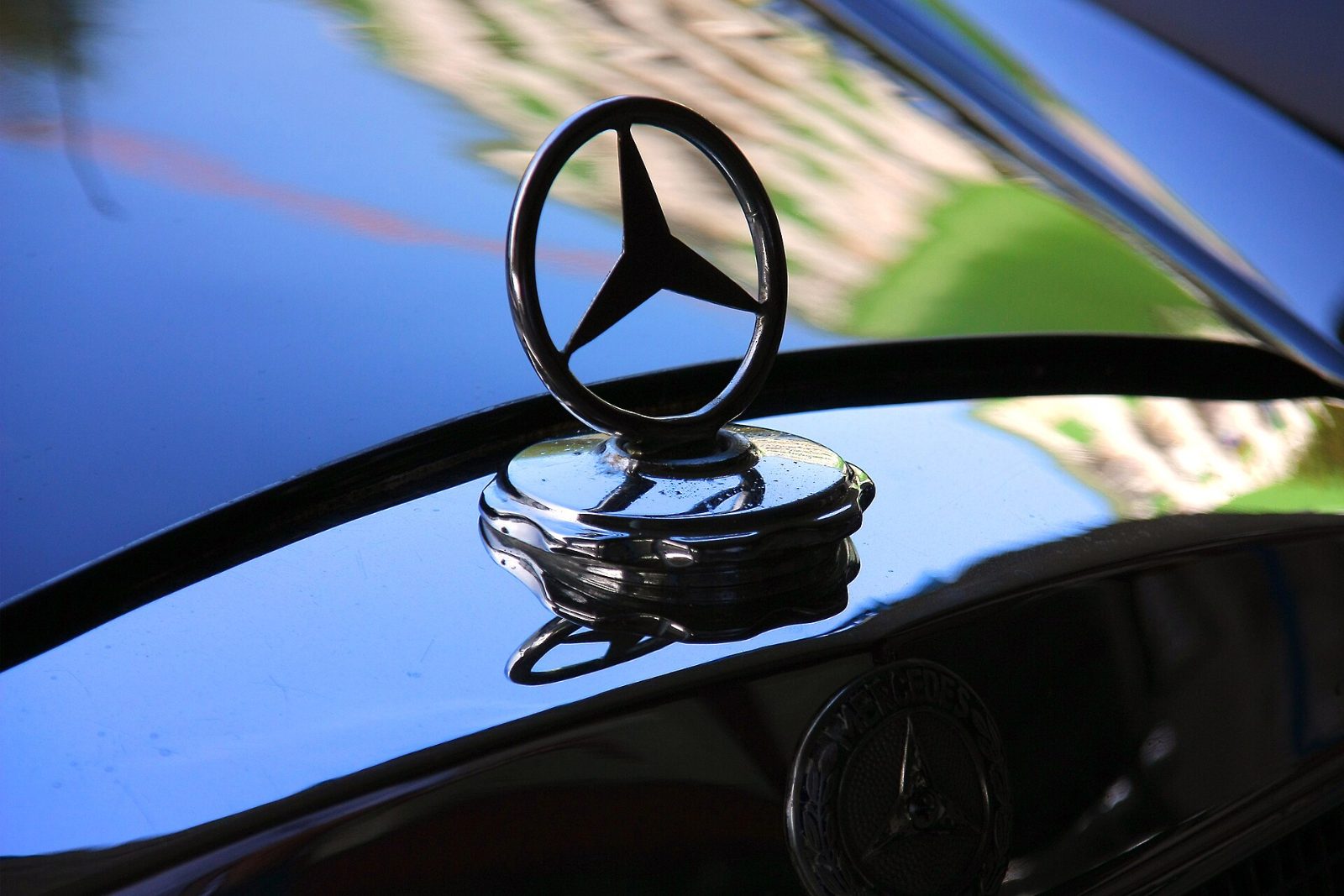
The Mercedes logo is a three-pointed star, usually set inside a circle. According to Mercedes-Benz, the three points stand for the founders’ ambition to motorise land, water and air. The star was registered as a trademark by Daimler-Motoren-Gesellschaft in 1909, and after the 1926 merger that created Daimler-Benz, it was combined with the laurel wreath of Benz & Cie. Today it is one of the most recognised badges in the world.
Two companies, two symbols
Mercedes-Benz grew out of two rival German pioneers.
- Daimler-Motoren-Gesellschaft (DMG), founded by Gottlieb Daimler and Wilhelm Maybach, built engines and cars and sold them under the Mercedes name from the early 1900s. The name came from the daughter of Emil Jellinek, an influential dealer and racer.
- Benz & Cie., founded by Carl Benz, whose 1886 Patent-Motorwagen is widely regarded as the first practical automobile.
Each company had its own identity. DMG adopted the three-pointed star. Benz used its name surrounded by a laurel wreath, a traditional symbol of victory reflecting its racing success.
Where the star came from
The story told by Mercedes-Benz is that Gottlieb Daimler once marked his house on a picture postcard with a star and wrote that it would one day shine over his factory. After his death, his sons Paul and Adolf suggested the star as the company’s trademark. DMG registered both a three-pointed and a four-pointed star in 1909 and chose the three-pointed version for its cars.
The three points are explained as Daimler’s goal of engines for use on land, on water and in the air, which DMG pursued with car, boat and aircraft engines.
How the logo evolved
| Period | Change |
|---|---|
| 1909 | Three-pointed star registered by DMG |
| 1910s | Star appears on radiators; later placed inside a ring |
| 1926 | DMG and Benz & Cie. merge into Daimler-Benz; star combined with Benz laurel wreath and both names |
| Mid-20th century | Simplified star in a plain ring becomes the main symbol |
| Today | Silver star used on cars; flat versions in digital media; illuminated stars on some models |
Exact dates for individual design variations vary by source, but the overall path from star, to star and wreath, to the clean ring is well documented by Mercedes-Benz Classic.
Logo essentials
- Symbol: three-pointed star in a circle
- Registered: 1909 by DMG
- Meaning: motorisation on land, water and air
- Merger badge: 1926, star combined with Benz laurel wreath
Standing star or grille star?
On the cars themselves, the star appears in two main ways:
- Standing star on the bonnet. A traditional ornament on luxury models such as many S-Class and E-Class versions, and on Maybach cars. It is spring-loaded so it folds on impact.
- Large star in the grille. Used on sportier models and many SUVs, giving a more modern, aggressive face.
Some recent models also offer an illuminated star in the grille and star patterns built into the grille design itself. Availability depends on model and market regulations.
Sub-brands and their badges
Mercedes uses related marks for its sub-brands:
- Mercedes-AMG: AMG lettering and a crest on high-performance models.
- Mercedes-Maybach: a double-M logo along with the star.
- Mercedes-EQ: the electric vehicle family, which used distinct styling and badging for its models.
- G-Class: keeps its own distinctive design details, but still carries the star.
If you are trying to identify a model or trim from its badges, our model line finder groups the current range by body and engine.
The logo in the UAE
The star is everywhere in the Gulf, from taxis to G-Class convoys. A few practical points for owners:
- Theft of standing stars. Bonnet ornaments are sometimes targeted by thieves. Replacement stars are available from dealers.
- Sun damage. Chrome and plastic badges can fade or pit over years in strong sun. Gentle washing helps.
- Aftermarket badges. Some owners fit AMG or Maybach badges to non-AMG cars. This can confuse buyers later and does not change the car’s specification.
Check the badges on used cars
Badges are cheap to change. Always confirm the actual model and engine with the registration documents and a VIN decode. Our Mercedes VIN guide shows how.
Spotting genuine and fake badges
Counterfeit Mercedes badges and accessories are widely available online. On a car, a fake badge is mostly a cosmetic issue, but it can signal that other parts are not genuine either. Signs of a non-original star include:
- Uneven chrome or plating that looks thin or bubbly.
- A star that sits slightly crooked or is not centred in its ring.
- Poor-quality adhesive or clips that do not match the mounting points.
- Packaging without proper part numbers.
Genuine replacement badges are sold through authorised Mercedes-Benz dealers and come with part numbers that match the car. If you are restoring a classic, Mercedes-Benz Classic and specialist clubs can help identify the correct badge for the year and model, since designs changed several times over the decades.
The star on classic Mercedes models
Collectors pay close attention to emblems on older cars. A W113 Pagoda SL, a W123 saloon or a W124 coupe each used specific badges and bonnet ornaments for their era. Incorrect badges can lower a car’s score at concours events and its appeal to serious buyers. Keeping original parts, or sourcing correct replacements, is part of a proper restoration.
Why the star matters to the brand
Mercedes-Benz treats the star as a promise of quality and engineering heritage. It appears on everything from trucks and vans to museum exhibits in Stuttgart. For many buyers, the logo is part of the reason they choose the brand, and its simplicity has allowed it to stay modern for more than a century.
Three points, one circle and more than a hundred years of history: the Mercedes star is a lesson in how a simple symbol can outlast every trend.
FAQ
What do the three points of the Mercedes star mean?
Mercedes-Benz says they represent the ambition to motorise land, water and air.
When was the Mercedes logo created?
The three-pointed star was registered as a trademark in 1909 by Daimler-Motoren-Gesellschaft.
Why is there a laurel wreath on old Mercedes logos?
It came from Benz & Cie. After the 1926 merger, the Daimler star and the Benz wreath were combined.
Is the illuminated Mercedes star legal in the UAE?
It is offered on some models where regulations allow. Check with your dealer about availability and approval for your car.
Sources: Mercedes-Benz Group, Mercedes-Benz Museum, Mercedes-Benz Classic
Cover photo: The original uploader was Aco at Chinese Wikipedia., CC BY-SA 3.0. Last reviewed: 2026-11-25.