
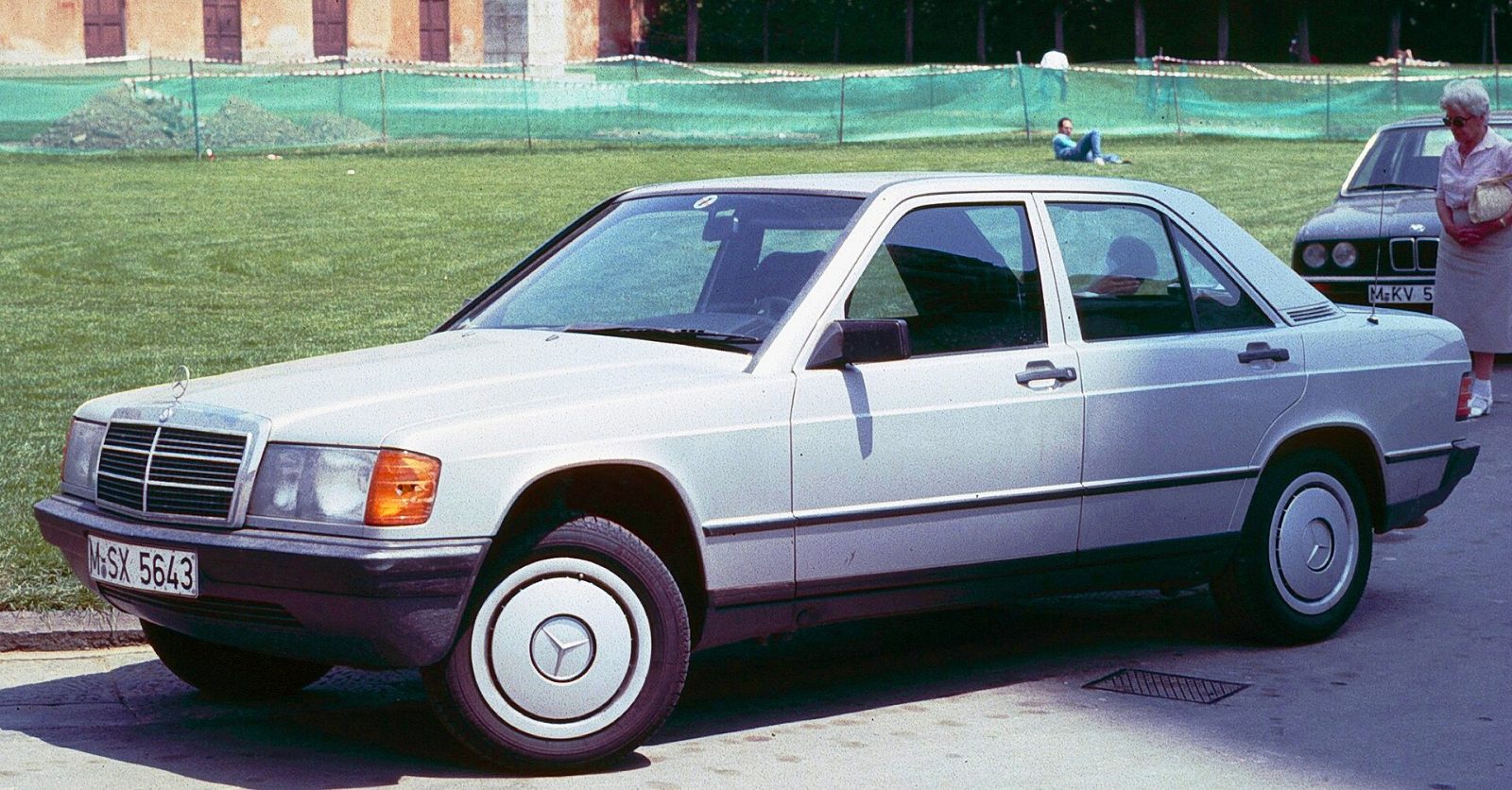
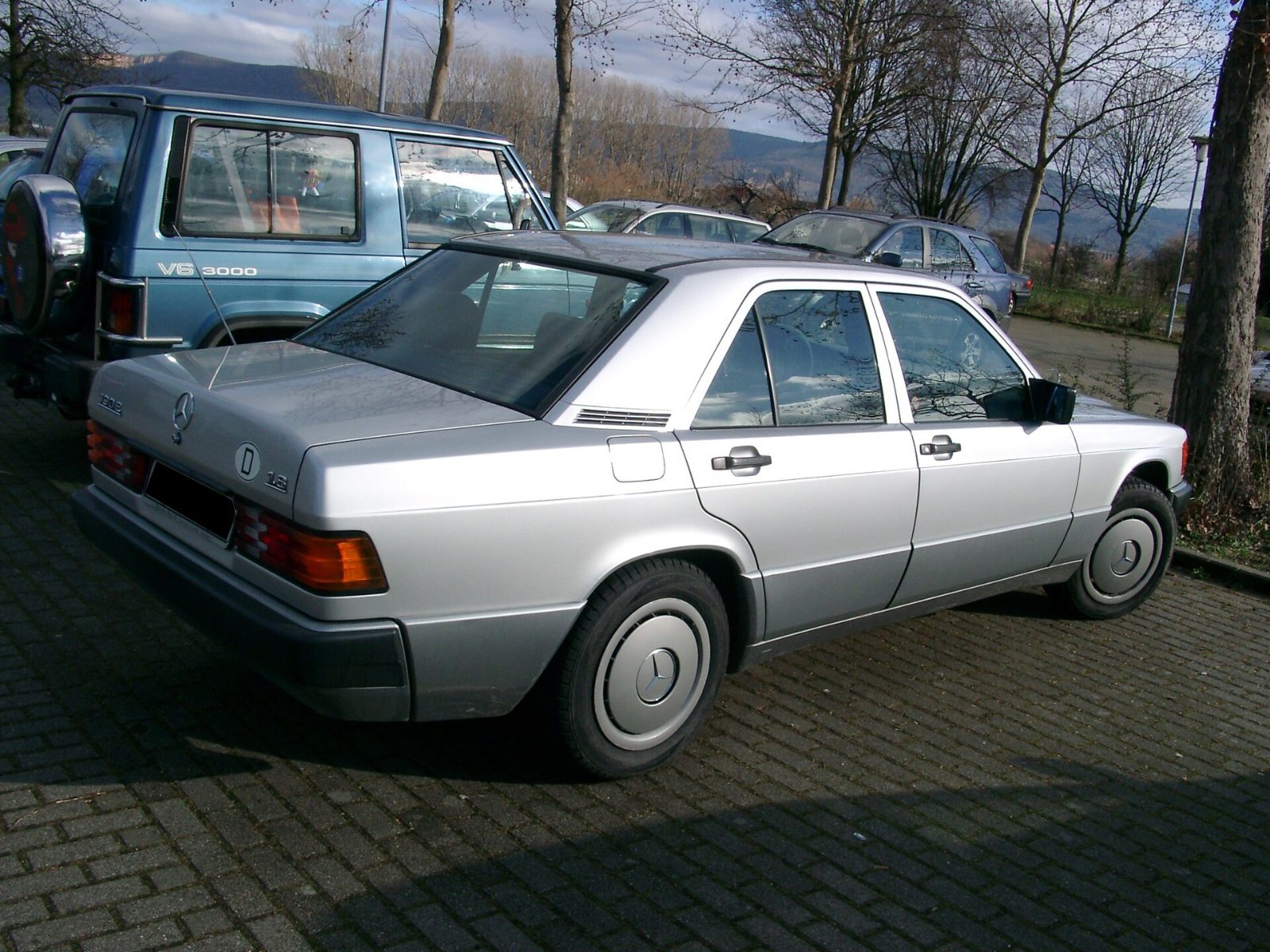
The Mercedes-Benz 190E is the fuel-injected version of the W201, the compact saloon Mercedes built from 1982 to 1993. Nicknamed the “Baby Benz”, it was the brand’s first modern small car and the direct ancestor of the C-Class. It was engineered to big-Mercedes standards, introduced an advanced multi-link rear suspension, and spawned motorsport legends such as the 190E 2.3-16 and the Evolution II.
Why the 190 was a big step
Before the W201, Mercedes did not sell a compact car. Rising fuel prices and emissions rules in the late 1970s pushed the company to build something smaller and more efficient without losing its reputation for safety and quality. The result was a car that felt solid like a larger Mercedes, with a strong body structure and a new five-link rear suspension that later appeared on larger models.
Nearly two million W201s were built, making it one of the most successful Mercedes models of its era.
The engine range
| Model | Engine | Character |
|---|---|---|
| 190 | 2.0 four-cylinder, carburettor | Entry model |
| 190 E | 2.0, later 1.8 and 2.3 fuel-injected fours | The common, everyday version |
| 190 E 2.6 | 2.6 straight-six | Smooth, quick, desirable |
| 190 D and 190 D 2.5 | Four and five-cylinder diesels | Economical, very durable |
| 190 D 2.5 Turbo | Turbo five-cylinder diesel | Strong diesel performance for its time |
| 190 E 2.3-16 and 2.5-16 | 16-valve four-cylinders | Sporting versions |
| 190 E 2.5-16 Evolution and Evolution II | Homologation specials | Built for touring car racing |
Exact engines varied by market and year, so check the data card for any specific car.
The 2.3-16 and the Senna race
The 190 E 2.3-16 used a 16-valve cylinder head developed with the British engineering firm Cosworth. It came with a body kit, sports seats and a dogleg five-speed gearbox on many cars.
At the opening of the new Nurburgring circuit in 1984, Mercedes organised a race in identical 190 E 2.3-16 cars driven by current and former Formula One drivers. A young Ayrton Senna won it, adding to the car’s legend.
The Evolution cars
To compete in the German touring car championship (DTM), Mercedes had to build road versions of its racing cars. This produced the 190 E 2.5-16 Evolution and then the Evolution II, each built in a limited run of around 500 cars. The Evolution II, with its large adjustable rear wing and wide arches, is one of the most recognisable Mercedes shapes of the period and is highly sought after today.
Quick identification tips
- 16-valve cars have a lower front spoiler, side skirts and a small boot lip or wing.
- Evolution II cars have a very large rear wing and flared wheel arches.
- Body kits have been copied, so always verify through the VIN and documents.
Common problems
- Rust: check the jacking points, wheel arches, the bottom of the front wings, the boot floor and around the windscreen.
- Rear suspension: worn bushings in the multi-link setup cause vague handling and knocks.
- Self-levelling suspension: 16-valve cars often have hydraulic rear self-levelling, which needs working spheres.
- Electrics: ageing wiring, switches and the central locking system.
- Wiring harness: some engine harnesses from the period used insulation that degrades with age and heat, causing running faults.
- Cooling: radiators, viscous fans and hoses need attention in hot climates.
Heat-related checks in the UAE
Test the air conditioning thoroughly; many cars need compressor, hose or evaporator work. Inspect rubber bushings, engine mounts and door seals, which harden quickly in Gulf heat. Dashboards often crack in strong sun.
Buying a 190E in the UAE
- Decide which version you want: an everyday 190 E, a smooth 2.6, a diesel, or a collectible 16-valve.
- Check documents and VIN. Our VIN guide explains how to read older Mercedes codes.
- For 16-valve and Evolution models, verify authenticity with build documents and, ideally, a specialist.
- Inspect underneath on a lift for rust and previous repairs.
- Check that the car can be registered and pass inspection in your emirate, especially if imported.
- Budget for rubber parts, cooling and air conditioning work even on tidy cars.
A clean, ordinary 190 E is a rewarding classic. A 16-valve or Evolution is an investment that needs proof of authenticity.
Design and safety
The 190 was styled under Bruno Sacco, the Mercedes design chief responsible for many of the brand’s best-loved shapes of the 1970s to 1990s. Its clean, wedge-like profile and high boot line were partly driven by aerodynamics, and the car had a low drag figure for a saloon of its time. The single wiper, which sweeps a large part of the windscreen with an extending arm, became a recognisable feature shared with later models.
Safety engineering was taken from larger Mercedes cars. The body used high-strength steel and a deformable front structure designed to perform in offset crashes, an area Mercedes was researching extensively at the time. Options such as ABS and, later, a driver airbag were available, though equipment varied widely by market and car. By modern standards the 190 is not a safe car, but it was well ahead of most compact saloons of its generation.
Living with one
A good 190 E is easy to drive and maintain, compact enough for city parking and simple enough for a capable independent mechanic. Parts support is generally good, and Mercedes-Benz Classic still supplies many genuine components. Regular use, covered parking and a fresh cooling system make Gulf ownership straightforward.
How the 190 fits Mercedes history
The W201 was replaced by the first C-Class (W202) in 1993, and the C-Class line has continued ever since. To see how the 190 relates to the C-Class generations and other classics, explore our Model Line Finder.
FAQ
Is the 190E the same as the C-Class?
It is the predecessor. The W201 190 series was replaced by the W202 C-Class in 1993.
What does the E mean in 190E?
It stands for Einspritzung, German for fuel injection, distinguishing it from the carburettor 190.
How many Evolution II cars were built?
Around 500 were made for homologation. Verify any car claimed to be one through documentation.
Is a 190E reliable as a classic?
Generally yes, when well maintained. Rust and ageing rubber are the main issues to check.
Sources: Mercedes-Benz, Mercedes-Benz Group, Mercedes-Benz Club of America
Cover photo: FotoSleuth, CC BY 2.0. Last reviewed: 2026-11-25.